Wire Size Calculator
Find the right wire gauge for any circuit from the amps, the voltage and the length of the run, checked for both ampacity and voltage drop.
All wire and conductor calculators
-
Voltage Drop Calculator
Voltage lost along a copper or aluminum run, in volts and percent.
-
Wire Ampacity Chart
How many amps a wire carries, with heat and bundling derating.
-
AWG Wire Gauge Chart
Diameter, area in mm² and kcmil, and resistance for every gauge.
-
Wire Resistance Calculator
Resistance of any length of wire, by metal, size and temperature.
-
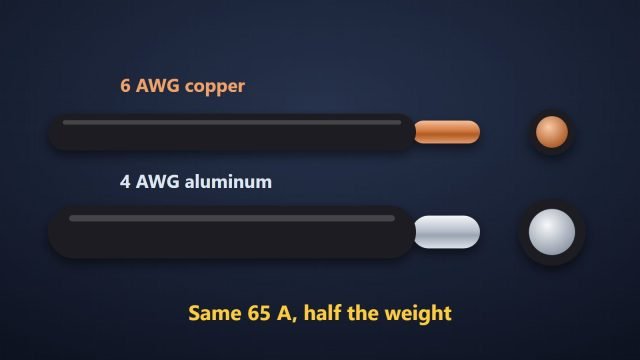
Copper to Aluminum Wire Size
The aluminum size that replaces a copper wire, and how they compare.
-
Conduit Fill Calculator
How full a conduit is, and the smallest size that fits your wires.
-
Box Fill Calculator
Required box volume for the wires, devices and clamps in a box.
How to use the wire size calculator
- Enter the load current. For a new circuit, use the breaker size. For one appliance, use the amps on its nameplate.
- Enter the voltage (120, 240, 208, 480, or 12 or 24 for DC) and the one-way length of the run, from the panel to the load.
- Pick copper or aluminum, and single-phase or three-phase.
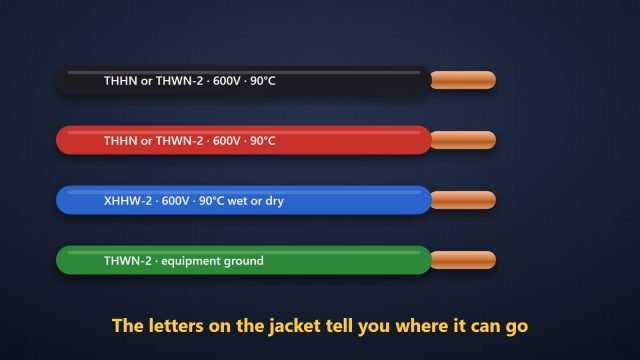
- Pick the temperature rating. NM-B (Romex) cable is always sized at 60°C. Individual THHN/THWN wires in conduit can use 75°C when the breaker and the equipment terminals are rated 75°C, which most modern ones are.
- Tick continuous load for anything that runs for three hours or more, such as an EV charger, a water heater or electric heat.
The calculator finds the smallest wire that carries the current and keeps the voltage drop under your limit, and shows the sizes either side so you can compare.
Two checks: ampacity and voltage drop
A wire has to pass two separate tests:
- Ampacity is how much current the wire can carry without its insulation getting too hot. It comes from NEC Table 310.16 and depends on the metal, the size and the temperature rating. See the wire ampacity chart.
- Voltage drop is the voltage lost in the wire’s resistance on the way to the load. It grows with the current and the length. The NEC recommends no more than 3% on a branch circuit and 5% in total. See the voltage drop calculator.
On short runs ampacity decides the size. On long runs, voltage drop usually takes over and calls for a bigger wire.
The formula
The voltage drop of a single-phase or DC circuit is:
Vd = 2 × I × R × L ÷ 1,000
- I is the current in amps.
- R is the resistance of the wire in ohms per 1,000 ft (NEC Chapter 9, Table 8).
- L is the one-way length in feet. The 2 counts the wire out and the wire back.
For three-phase circuits, replace the 2 with 1.732 (the square root of 3).
Example: a 40 A, 240 V circuit 100 ft long in copper NM-B cable. At 60°C, 8 AWG copper is rated 40 A, so it passes the ampacity test. Its resistance is 0.778 Ω per 1,000 ft, so Vd = 2 × 40 × 0.778 × 100 ÷ 1,000 = 6.2 V, which is 2.6% of 240 V. That is under 3%, so the answer is 8 AWG copper.
Wire size chart by amps
For short runs where voltage drop is not a problem. Longer runs may need a bigger wire.
| Circuit | Copper, 60°C (NM-B) | Copper, 75°C (THHN) | Aluminum, 75°C |
|---|---|---|---|
| 15 A | 14 AWG | 14 AWG | 12 AWG |
| 20 A | 12 AWG | 12 AWG | 10 AWG |
| 30 A | 10 AWG | 10 AWG | 8 AWG |
| 40 A | 8 AWG | 8 AWG | 8 AWG |
| 50 A | 6 AWG | 8 AWG | 6 AWG |
| 60 A | 4 AWG | 6 AWG | 4 AWG |
| 80 A | 3 AWG | 4 AWG | 2 AWG |
| 100 A | 1 AWG | 3 AWG | 1 AWG |
Small wires have their own limits in NEC 240.4(D): 14 AWG copper on no more than a 15 A breaker, 12 AWG on 20 A and 10 AWG on 30 A, whatever the table says. More detail is in what size wire for 15 to 100 amps.
Things the calculator does not cover
- Hot or crowded locations. Wire in a hot attic, on a sunny roof or bundled with many other circuits carries less current. Use the ampacity calculator to apply the correction factors.
- Motors, HVAC and EV chargers have their own sizing rules. Follow the nameplate’s minimum circuit ampacity (MCA) and the installation manual.
- Dwelling services and main feeders may use the smaller sizes allowed by NEC 310.12.
- Local codes and inspectors have the final word. When in doubt, ask a licensed electrician.
Frequently asked questions
What size wire do I need for 50 amps?
6 AWG copper in NM-B cable, or 8 AWG copper THHN in conduit where everything is rated 75°C. In aluminum, 6 AWG. Runs longer than about 100 ft at 240 V may need one size larger for voltage drop.
Can I use a bigger wire than the calculator says?
Yes. A larger wire is always allowed and lowers the voltage drop; it only costs more and can be harder to fit in the breaker and device terminals. Never use a smaller one.
Does the neutral need to be the same size?
Usually yes for branch circuits. The equipment ground can be smaller: NEC Table 250.122 sets its size from the breaker rating.
Latest guides
All guides-

Copper vs Aluminum Wire: Cost, Safety and Sizing
How copper and aluminum wire compare on conductivity, size, weight, cost and safety, why aluminum got a bad name, and where each makes sense today.
-
THHN vs THWN-2 and Other Wire Types Explained
What the letters printed on wire mean, the difference between THHN and THWN-2, and where NM-B, UF-B, XHHW-2, USE-2 and SER cable belong.
-
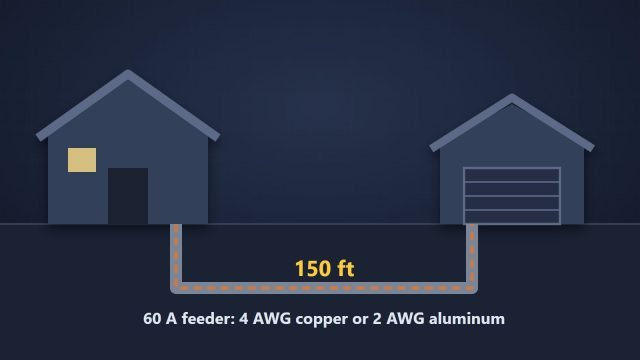
Wire Size for a Detached Garage, Shop or Shed
How to size the feeder to a detached garage, workshop or shed, why distance matters more than the breaker, and the rules for burial depth and grounding.