AWG Explained: How the Wire Gauge System Works
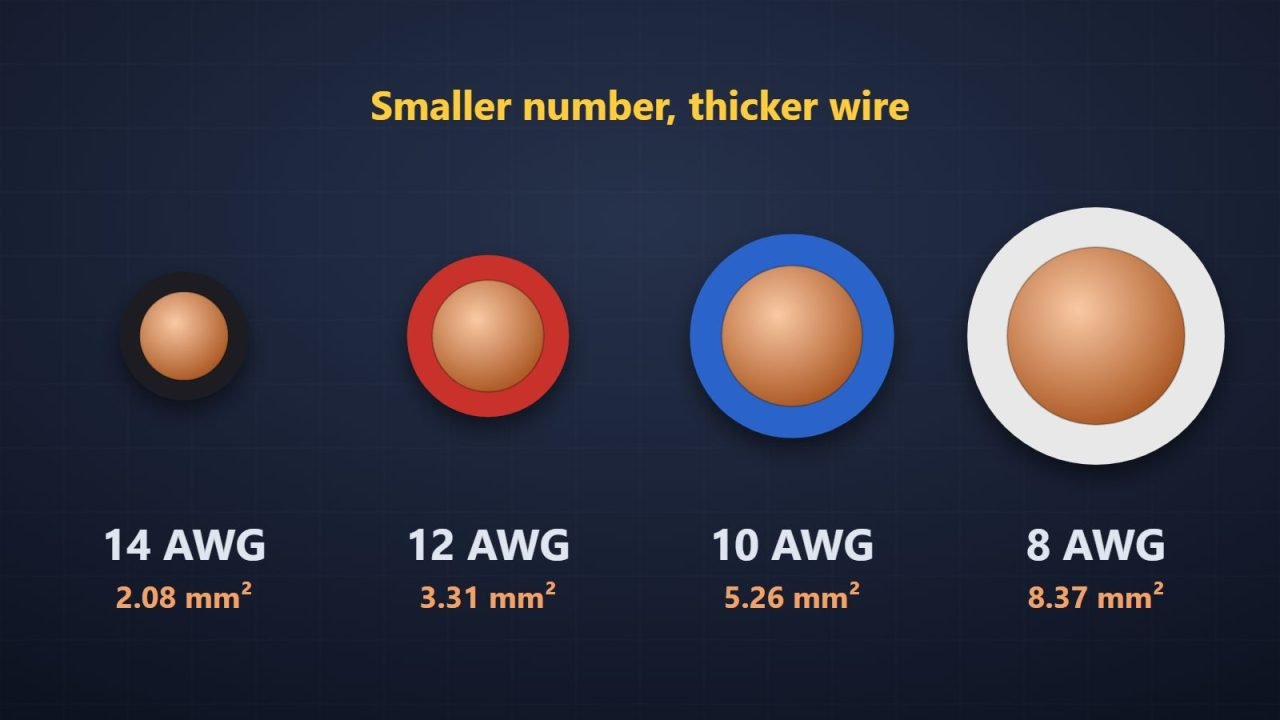
American Wire Gauge (AWG) is the system used for electrical wire in North America. It looks backward at first: 14 gauge is thinner than 12, and 12 thinner than 10. Once you know where the numbers come from, the AWG wire gauge system is easy to use.
Why bigger numbers are thinner
Wire is made by pulling metal rod through a series of smaller and smaller dies. The gauge number started as a count of those drawing steps: the more times a wire was drawn, the thinner it became. In 1857 the Brown & Sharpe company fixed the sizes to a mathematical series, which became AWG.
The formula
AWG defines 36 gauge as 0.005 in and 0000 (4/0) gauge as 0.46 in, with 39 equal steps between them on a ratio scale:
d = 0.005 in × 92(36 − n) ÷ 39
Each step changes the diameter by about 12.3%. That gives three rules worth remembering:
- 3 gauges smaller number = double the area, half the resistance. 12 AWG has twice the copper of 15 AWG.
- 6 gauges = double the diameter. 4 AWG is twice as thick as 10 AWG.
- 10 gauges = ten times the area. 10 AWG copper is about 1 Ω per 1,000 ft, 20 AWG about 10 Ω and 30 AWG about 100 Ω.
The sizes above 1 AWG
After 1 AWG come 0, 00, 000 and 0000, written 1/0, 2/0, 3/0 and 4/0 and spoken “one aught” to “four aught”. Above 4/0 the gauge system stops and wire is named by its area in thousands of circular mils: 250 kcmil, 300 kcmil, up to 2,000 kcmil. Older drawings write MCM for the same thing.
A circular mil is the area of a circle 0.001 in across, which makes the arithmetic easy: a wire’s area in circular mils is its diameter in thousandths of an inch, squared. 12 AWG is 80.8 mils across, so 80.8² = 6,530 circular mils.
Common sizes at a glance
| AWG | Diameter | Area | Copper Ω per 1,000 ft (20°C) |
|---|---|---|---|
| 18 | 1.02 mm | 0.82 mm² | 6.39 |
| 14 | 1.63 mm | 2.08 mm² | 2.53 |
| 12 | 2.05 mm | 3.31 mm² | 1.59 |
| 10 | 2.59 mm | 5.26 mm² | 1.00 |
| 8 | 3.26 mm | 8.37 mm² | 0.628 |
| 6 | 4.11 mm | 13.3 mm² | 0.395 |
| 4 | 5.19 mm | 21.2 mm² | 0.249 |
The full table from 4/0 to 40 AWG, with a converter from diameter and mm², is in the AWG wire gauge chart.
Solid and stranded wire
The gauge describes the metal area, not the outside size. A stranded 12 AWG wire has the same area as a solid one, so it carries the same current, but it measures slightly larger because of the gaps between strands. That is why measuring stranded wire with a caliper can mislead you by a size. Count the strands and measure one instead, or read the print on the insulation.
AWG and metric sizes
Most of the world sizes cable by its area in mm² (IEC 60228). The sizes do not line up exactly:
- 1.5 mm² falls between 16 and 14 AWG.
- 2.5 mm² is between 14 and 12 AWG, closest to 13.
- 4 mm² is a little bigger than 12 AWG; 6 mm² a little bigger than 10 AWG.
When converting, always pick the size that is at least as large in area, and check the ampacity rules of the country where the wire is installed.
Other gauges
Sheet metal, jewelry wire, music wire and hypodermic needles all use different gauge systems, so a “16 gauge” steel sheet has nothing to do with 16 AWG wire. Speaker cable, automotive wire and electronics hookup wire in North America do use AWG.