THHN vs THWN-2 and Other Wire Types Explained
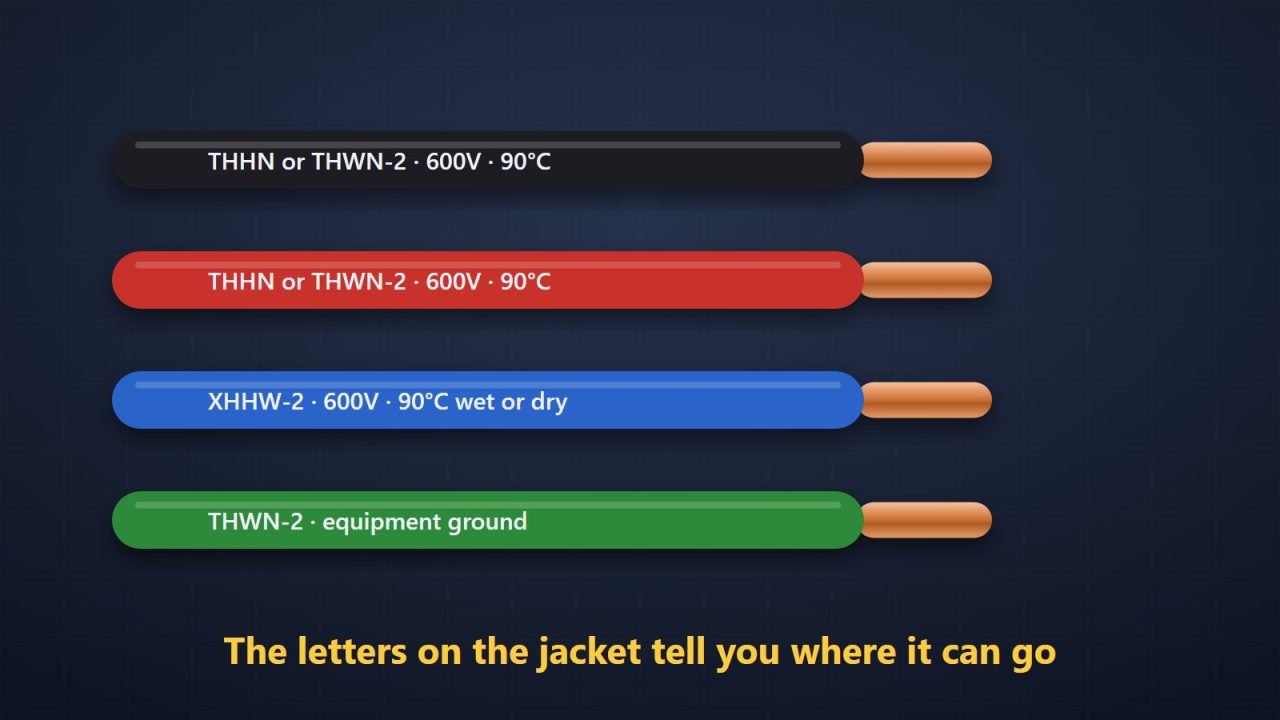
The letters printed on electrical wire tell you what the insulation is made of, how hot it can run and whether it can get wet. Here is how to read them, starting with the most common question: THHN vs THWN.
Decoding the letters
| Letter | Meaning |
|---|---|
| T | Thermoplastic insulation (PVC) |
| H | Heat resistant, rated 75°C |
| HH | High heat resistant, rated 90°C |
| W | Wet locations allowed |
| N | Nylon jacket over the insulation, for toughness and slipperiness |
| X | Cross-linked polyethylene insulation (XLPE) |
| R | Rubber (thermoset) insulation |
| -2 | Rated 90°C in wet locations too |
THHN vs THWN vs THWN-2
- THHN: PVC with a nylon jacket, 90°C, dry and damp locations only.
- THWN: the same build, 75°C, wet locations allowed.
- THWN-2: 90°C in wet or dry locations.
In practice, almost all wire sold today is printed with several ratings at once, such as “THHN or THWN-2”, so one spool serves both. Underground conduit and outdoor conduit count as wet locations, so the wire there must carry a W rating.
Does 90°C mean more amps?
Only partly. The 90°C column of the ampacity chart is the starting point when you derate for heat or bundling, but the final ampacity cannot exceed what the terminals at each end are rated for, usually 75°C, and for small circuits often 60°C (NEC 110.14(C)). So 12 AWG THHN still goes on a 20 A breaker; the 90°C rating gives you headroom in a hot attic or a full conduit.
Cable types
| Type | What it is | Where it goes |
|---|---|---|
| NM-B (Romex) | Insulated wires and a bare ground in a plastic sheath | Dry indoor locations in houses. Sized at 60°C. |
| UF-B | Wires molded into a solid plastic jacket | Wet locations and direct burial. Sized at 60°C. |
| MC | Wires in an interlocked metal armor | Commercial buildings, exposed runs. |
| SER / SEU | Large aluminum or copper service cable | Service entrance, feeders to subpanels and ranges. |
| USE-2 | Single wire with tough insulation | Direct burial, underground service, solar. |
| XHHW-2 | Single wire with XLPE insulation | Conduit, wet or dry; common for aluminum feeders. |
Colors
- Green, green with yellow, or bare: equipment ground only.
- White or gray: neutral only, apart from a few marked exceptions.
- Black, red, blue and others: ungrounded (hot) conductors. Commercial 480 V systems often use brown, orange and yellow.
Sizes 4 AWG and larger may be any color and marked with tape at each end.
Frequently asked questions
Can I use THHN outside?
Only if it is also marked THWN or THWN-2, which nearly all of it is. Plain THHN is for dry and damp locations.
Can I run THHN without conduit?
No. Single building wires must be in a raceway. If you need wire without conduit, use a cable type such as NM-B indoors or UF-B outdoors.
Once you know the type, the conduit fill calculator tells you how many fit in a pipe.