How to Calculate Voltage Drop (With Worked Examples)
Every wire has some resistance, so some of the voltage is used up pushing current along it before it reaches the load. Here is how to calculate voltage drop by hand, for any circuit, and how to use the same formula to choose a wire size.
What you need
- The current (I) in amps. Use the actual load, or the breaker size for a worst case.
- The one-way length (L) of the run in feet.
- The resistance (R) of the wire in ohms per 1,000 ft, from NEC Chapter 9 Table 8, or the wire resistance calculator.
- The source voltage, to turn the result into a percentage.
Step 1: pick the formula
| Circuit | Formula |
|---|---|
| Single-phase AC (120 V or 240 V) and DC | Vd = 2 × I × R × L ÷ 1,000 |
| Three-phase AC | Vd = 1.732 × I × R × L ÷ 1,000 |
The 2 counts the wire out and the wire back. In a balanced three-phase circuit the return current is shared between the phases, so the factor is the square root of 3.
Step 2: work it out
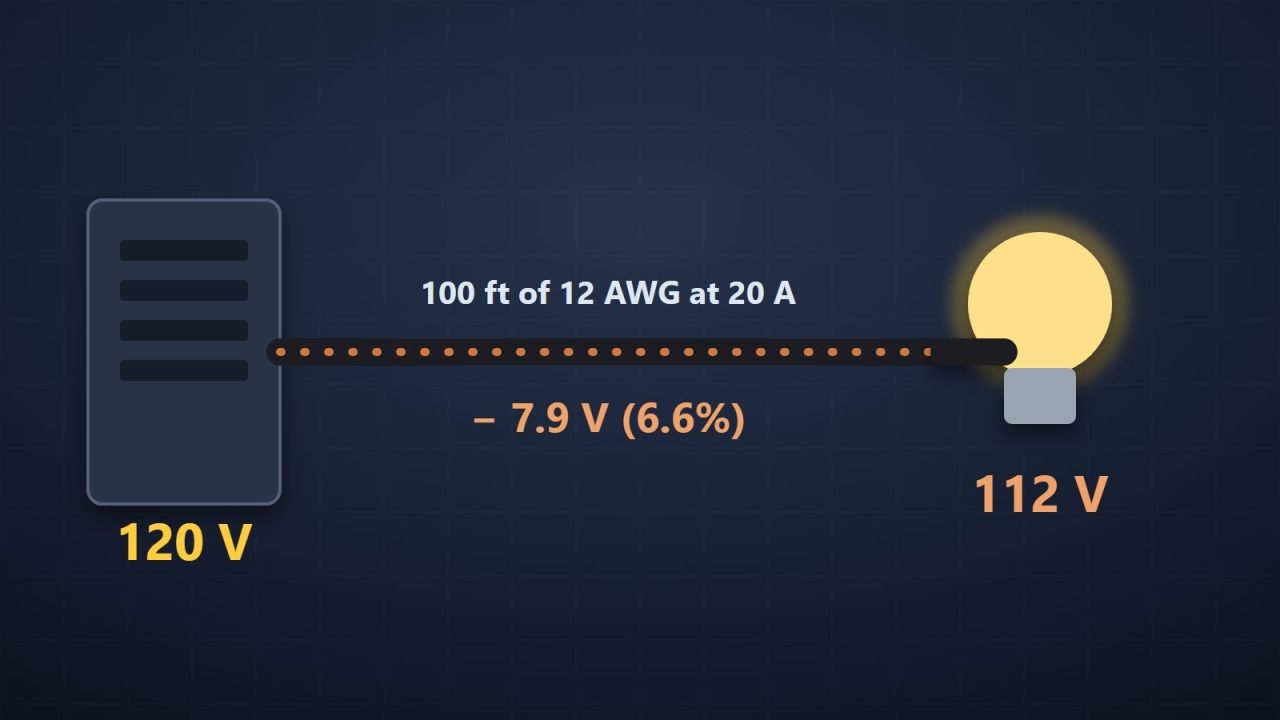
Example 1, a 120 V branch circuit. A 20 A load, 100 ft from the panel, on 12 AWG copper (1.98 Ω per 1,000 ft):
Vd = 2 × 20 × 1.98 × 100 ÷ 1,000 = 7.92 V
7.92 ÷ 120 = 6.6%. Only 112 V reaches the load.
Example 2, a three-phase feeder. 100 A at 480 V, 300 ft of 1/0 copper (0.122 Ω per 1,000 ft):
Vd = 1.732 × 100 × 0.122 × 300 ÷ 1,000 = 6.34 V
6.34 ÷ 480 = 1.3%. High voltage makes long runs easy.
Example 3, a 12 V DC run. 10 A, 20 ft from the battery, on 12 AWG copper:
Vd = 2 × 10 × 1.98 × 20 ÷ 1,000 = 0.79 V
0.79 ÷ 12 = 6.6%, from a run of only 20 ft. Low-voltage systems need much thicker wire for the same power.
Step 3: compare with the limit
The NEC recommends no more than 3% on a branch circuit and 5% for the feeder and branch circuit together. Example 1 fails; example 2 passes easily; example 3 depends on the equipment, but most 12 V devices want 3% or less.
Turning it round: the wire size for a given drop
The circular-mil form of the formula lets you solve for the wire size directly:
CM = 2 × K × I × L ÷ Vd
K is the resistance of a one-circular-mil, one-foot wire: about 12.9 for copper and 21.2 for aluminum at 75°C. For example 1 at 3% (3.6 V):
CM = 2 × 12.9 × 20 × 100 ÷ 3.6 = 14,333 circular mils
10 AWG is 10,380 circular mils, too small; 8 AWG is 16,510, so 8 AWG is the answer. For three-phase, use 1.732 in place of the 2. The wire size calculator does this and checks the ampacity too.
Common mistakes
- Using the round-trip length and the factor 2 together. Use one or the other, never both.
- Using resistance at 20°C. A loaded wire is warmer; the 75°C table values are the standard.
- Forgetting the feeder. A 2% drop in the feeder plus 3% in the branch circuit already reaches the 5% total.
- Ignoring motor starting. Motors draw several times their running current for a moment, so a run that is fine when running can still dim the lights at start-up.
Or skip the arithmetic: the voltage drop calculator shows the result for every wire size at once.